Projects
Browse all projects. Open a project for its summary, work, and available links.
R6 Replay Lab
project overview
View full case study >_R6 Replay Lab
research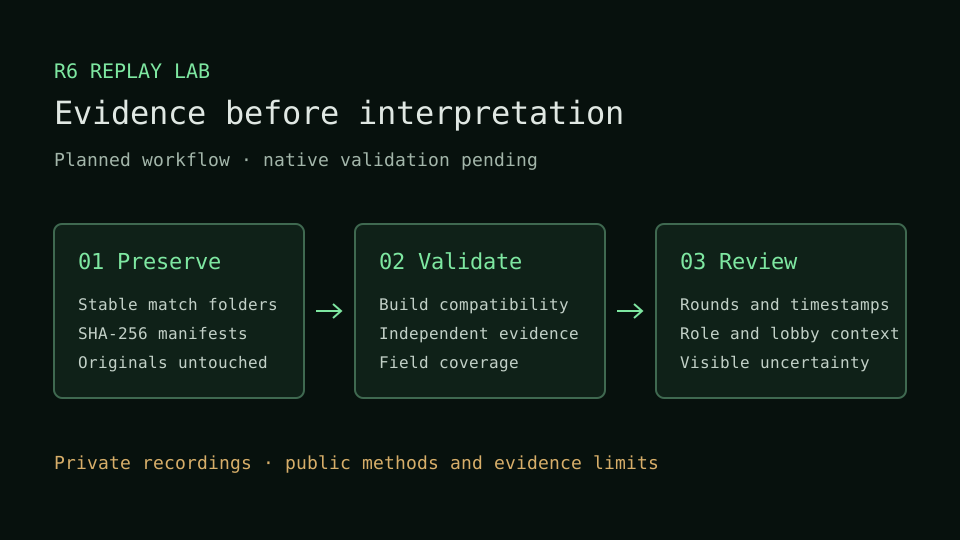
A local replay-analysis project for testing Rainbow Six Siege performance hypotheses against round-level evidence.
project details
I am starting a replay-analysis lab to understand how performance changes across roles, teams and eras. The project begins with preserving recordings and validating parser output, then connects round events to specific review questions. The repository currently holds the specification and intake checkpoint; native replay analysis remains unvalidated.
Limitations
- The original starter package has not been imported or independently tested. Personal recordings and account mappings remain private.
- Python (planned)
- Replay event data
- Evaluation design
- Data provenance
- Performance analysis
quick links
project facts
- Category
- Games & Simulation
- Status
- research
- Context
- Personal
- Dates
- Oct 2026 – present
Balcony Aquaponics System
project overview
View full case study >_Balcony Aquaponics System
research[ asset: aquaponics-system-visual ]Screenshot or diagram for Balcony Aquaponics System.A public-safe planning draft for a compact aquaponics loop, with flow, rack, plumbing and safety diagrams.
project details
I am turning a personal aquaponics idea into a reviewable system plan. The public draft keeps the home layout generalized, labels planning inputs separately from page-level checks, and leaves structural, electrical, hydraulic and livestock decisions open until they are validated.
What I built
- Defined a proposed fish-to-filter-to-grow loop with separate normal-flow, solids and emergency-drain paths.
- Turned open structural, electrical, hydraulic and stocking questions into an explicit review checklist instead of presenting them as solved.
Limitations
- This is a proposed system, not a verified installation. Rack loading, floor loading, tip resistance, access and egress, overflow sizing, electrical protection and livestock compatibility still require review.
- The public page intentionally omits exact home-layout measurements and personal location details. It uses generalized diagrams for discussion.
- Candidate livestock are examples from planning conversations, not a validated stocking list or compatibility recommendation.
- SVG
- HTML
- Water-flow planning
- Systems planning
- Technical communication
- Safety review
- Diagramming
quick links
project facts
- Category
- Systems
- Status
- research
- Context
- Personal
- Dates
- Oct 2026 – present
Agent Toolkit
project overview
View full case study >_Agent Toolkit
active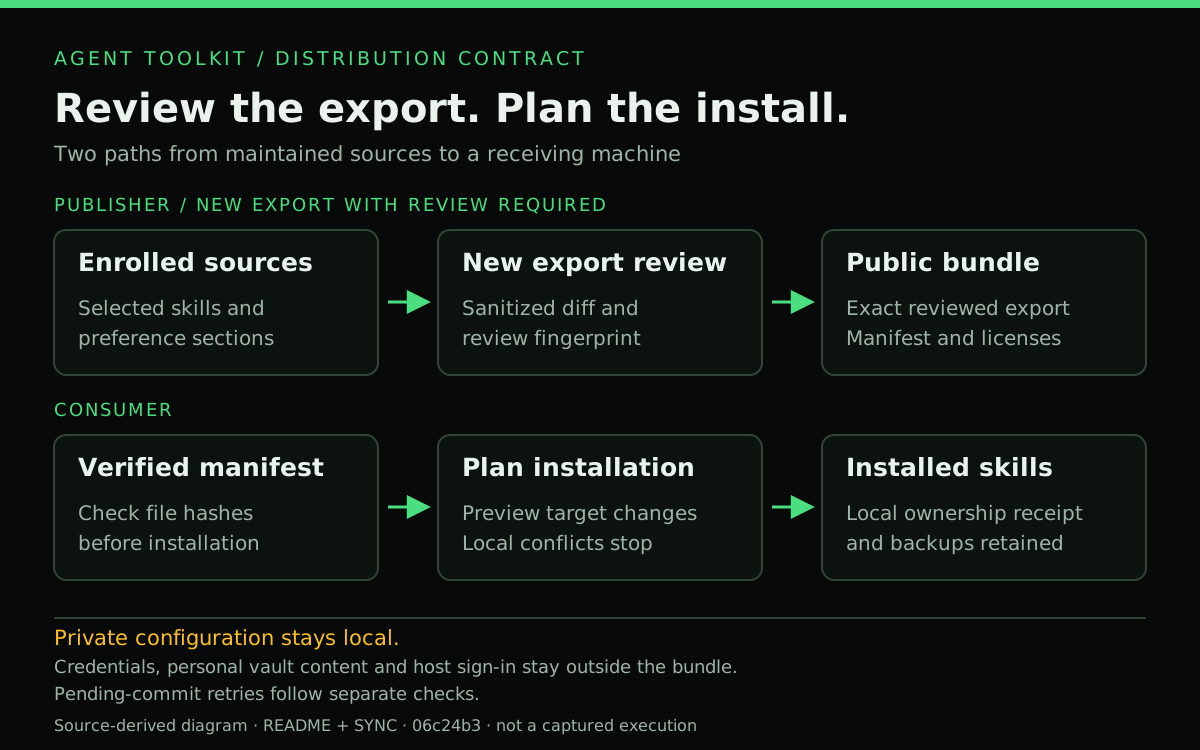
My portable coding-agent setup: reusable skills and working preferences, reviewed public sync, and installation that preserves local edits.
project details
I packaged my coding-agent working system so I can restore it across machines and share the reusable parts. The bundle separates public instructions from private machine state, binds new exports to review fingerprints in the configured publishing flow, and tracks the files it installs. It includes target layouts for Codex, Claude Code, Gemini CLI and OpenCode, while native tools and sign-ins remain separate setup steps.
What I built
- Designed the working preferences, task-dependent methods, skill routing and integration that make up my coding-agent system.
- Built the portable distribution, export policy and fingerprint check for newly reviewed exports.
- Built installation, update and removal around file ownership, local-edit detection and managed instruction blocks.
- Adapted selected upstream methods into the system while preserving their source identities, licenses and author credit.
- 25 enrolled standalone skills at 06c24b3
- 23 tests passed on each of 3 CI operating systems
- Preview-first install; reviewed publication
Limitations
- The CI checks cover distribution and installation behavior. They do not measure agent productivity or prove every skill can invoke its tools in every host.
- Account sessions, native plugins, permissions and host-specific configuration are restored separately. Automatic publication depends on the configured publisher being online.
- JavaScript
- Node.js
- Git
- GitHub Actions
- Markdown
- Agent orchestration
- Developer tooling
- Reproducible setup
quick links
project facts
- Category
- Agent SystemsTools
- Status
- active
- Context
- Personal
- Dates
- Sep 2026 – present
- Related
- Lifeline
OSRS Market Tools (MMG)
project overview
View full case study >_
OSRS Market Tools (MMG)
active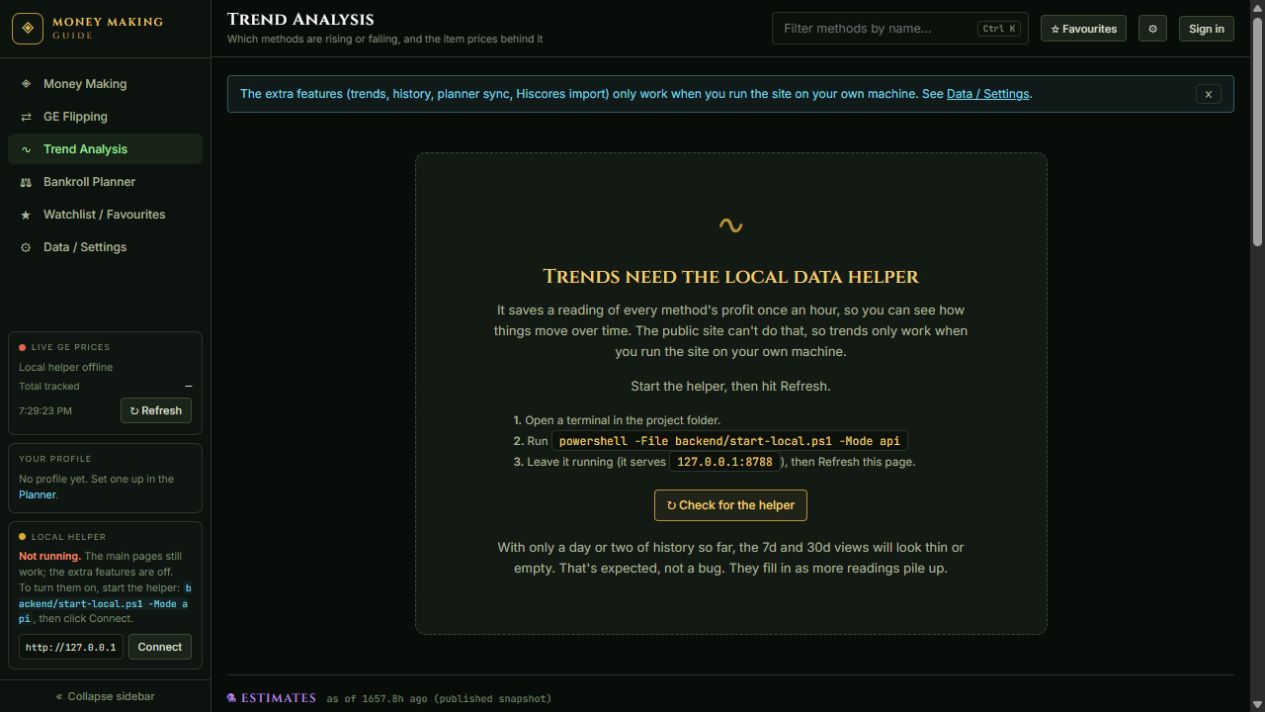
An OSRS market-analysis app whose research found predictive skill, losing trades, and a label bug that changed what four hours meant.
project details
I built browser tools for comparing Old School RuneScape money-making methods and Grand Exchange margins, then tested whether price forecasts could support trading decisions. Historical studies reported predictive gains but losing trading strategies. An exact-horizon rebuild redirected the research toward risk context, and a later audit found feature and freshness defects that require revalidation before those gains can support the displayed rankings.
- Historical research scope: 4,420 items, 627 money-making methods, and 1.55M observations; live catalog counts change
- Direction prediction: 57.43% accuracy vs 54.86% baseline (95% CI 56.76 to 58.14)
- Next-day volatility: 30.4% MAE improvement over rolling baseline
- Tax-hurdle selection: 0.727 ROC-AUC, 2.65x precision lift
- Tax math audit: 50,512 browser vs backend comparisons, zero mismatches
Limitations
- Unofficial fan tooling, not affiliated with or endorsed by Jagex. Old School RuneScape is a trademark of Jagex Ltd.
- Price data sourced from the community-run OSRS Wiki real-time prices API, with attribution. Figures can be stale or incomplete.
- Analysis and research only. No trading automation is exposed, and ML output is research-only, never a trade signal.
- Python
- Pandas
- OSRS Wiki API
- Time-series ML
- Evaluation methodology
- Data pipelines
- Full-stack development
quick links
project facts
- Category
- ML Research
- Status
- active
- Context
- Personal
- Dates
- Jul 2026 – present
Dino Arena
project overview
View full case study >_
Dino Arena
active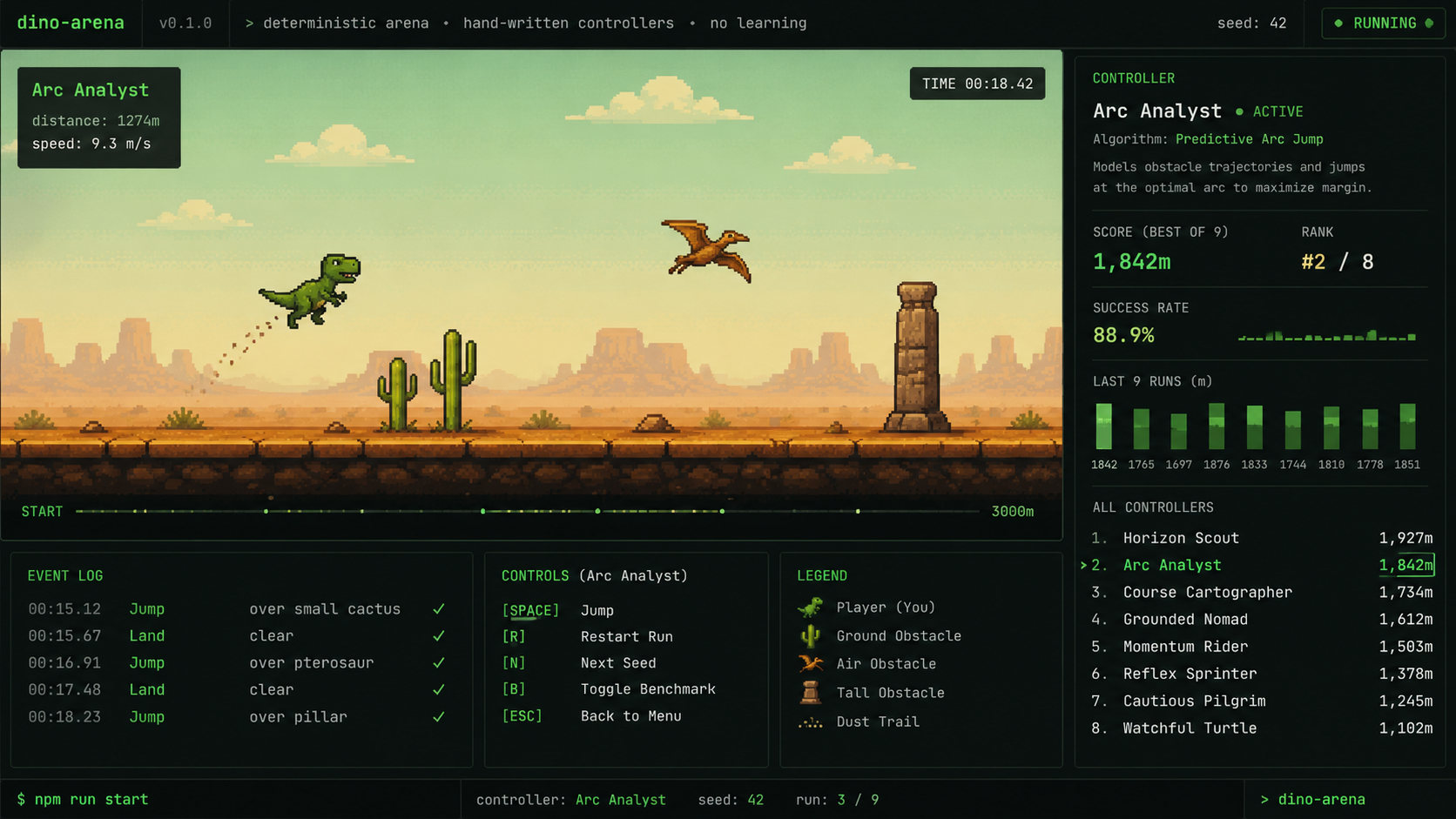
A deterministic runner for comparing hand-written controllers with explicit observation and planning budgets.
project details
Deterministic, seeded two-lane browser runner built for human-vs-agent play and reinforcement-learning evaluation. One headless simulation drives the browser game, a controller roster, and a benchmark harness.
- 12/12 tests pass (~0.8s); npm run lint and npm run build both clean
- Historical benchmark, 9 fixed seeds: analytical solver and 2 rollout controllers clear all 9
- 3 reactive heuristics clear 0% of seeds, 9-29% median course progress
- 1,351 lines of simulation + test logic (core.ts 509, agents.ts 435, renderer.ts 240, tests 167)
Limitations
- No trained model exists in this repo. The roster contains seven hand-written autonomous policies and one manual keyboard mode. The RL-shaped DinoEnvironment adapter (reset/step/serialize with a reward signal) is scaffolding, not a finished training pipeline.
- TypeScript
- Canvas
- Headless simulation
- Simulation design
- RL evaluation
quick links
project facts
- Category
- Games & Simulation
- Status
- active
- Context
- Personal
- Dates
- Jul 2026 – present
- Related
- AI Bomber, AI Frogger, Pulse Court
Pulse Court
project overview
View full case study >_
Pulse Court
active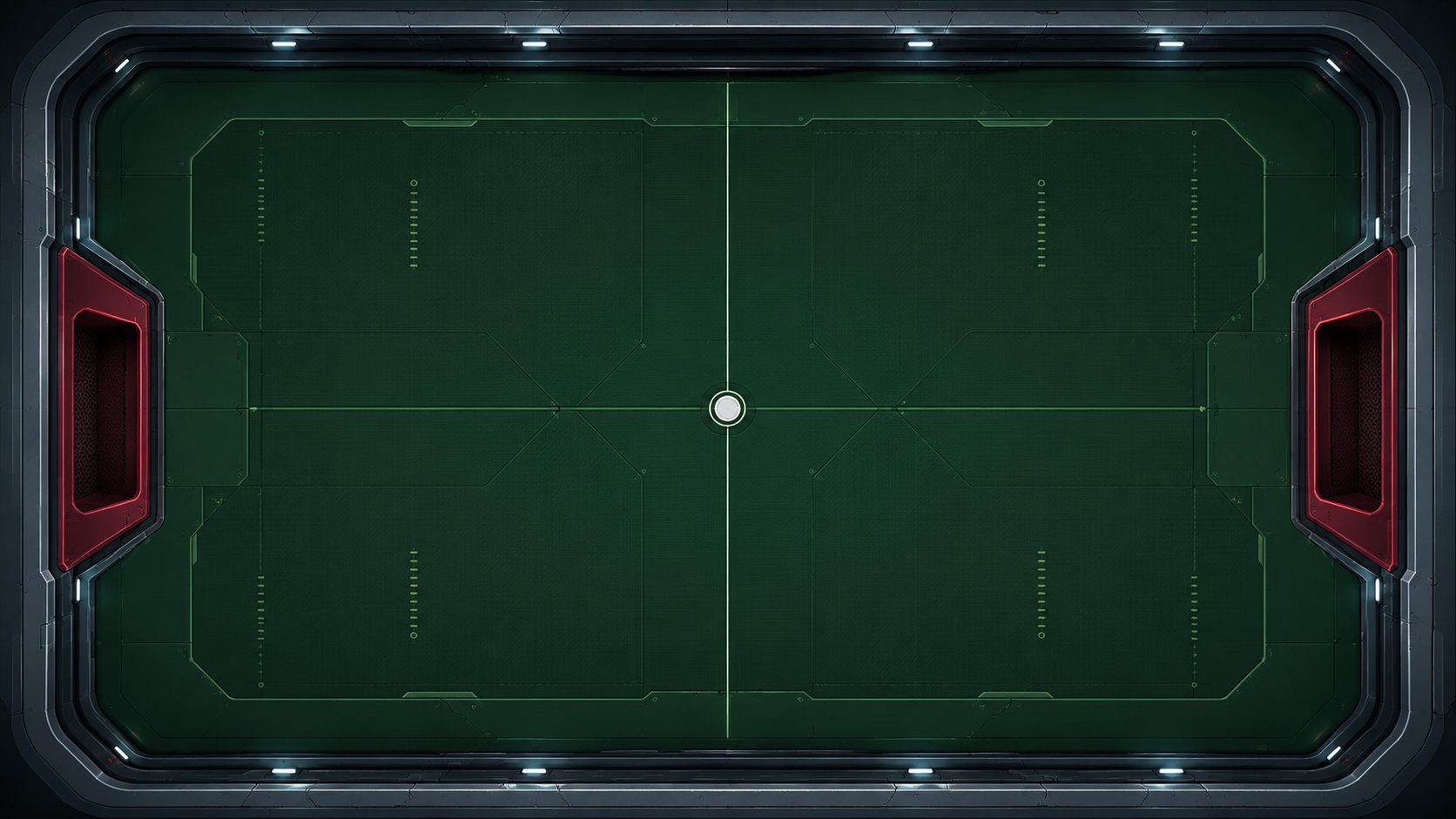
A deterministic arena game where policy execution is checked against recorded inputs and replayed state, rather than inferred from a successful load.
project details
I built a fixed-point C++20 arena simulator, native viewer, and policy execution path around reproducible matches. An integration audit found that loading a policy could still leave scripted actions in control. The repaired preview records native network decisions, and a later local ruleset migration matches the reference on synthetic contract probes. Trained-policy certification remains open.
- 120 Hz fixed-point simulation with a separate 10 Hz policy cadence
- 6 synthetic-policy preview games, 9,483 network decisions, all 6 replays verified (September 18, 2026)
- 4 CTest suites passed in both Release and Debug at source commit 661f35d
Limitations
- The local v4 migration passes synthetic simulator and native-adapter checks, but is not merged or deployed. Strict deployment remains disabled pending accepted certification and artifact-identity checks.
- Synthetic development policies exercise loading, inference, and replay plumbing. They are untrained and provide no evidence of competitive strength or certification.
- Release and Debug builds, automated suites, native policy execution, and replay verification passed at the September 18 checkpoint. Fresh GUI/input, rendering, and device-loss acceptance remain unverified.
- Local Windows prototype only. Networking and team sizes beyond 1v1 remain deferred, and gameplay rendering has not migrated to Direct2D.
- C++20
- Win32
- Direct2D
- GDI/GDI+
- CMake
- Deterministic simulation
- Replay verification
- Native policy inference
quick links
project facts
- Category
- Games & Simulation
- Status
- active
- Context
- Personal
- Dates
- Jul 2026 – present
- Related
- Dino Arena, AI Bomber, AI Frogger
AI Bomber
project overview
View full case study >_
AI Bomber
research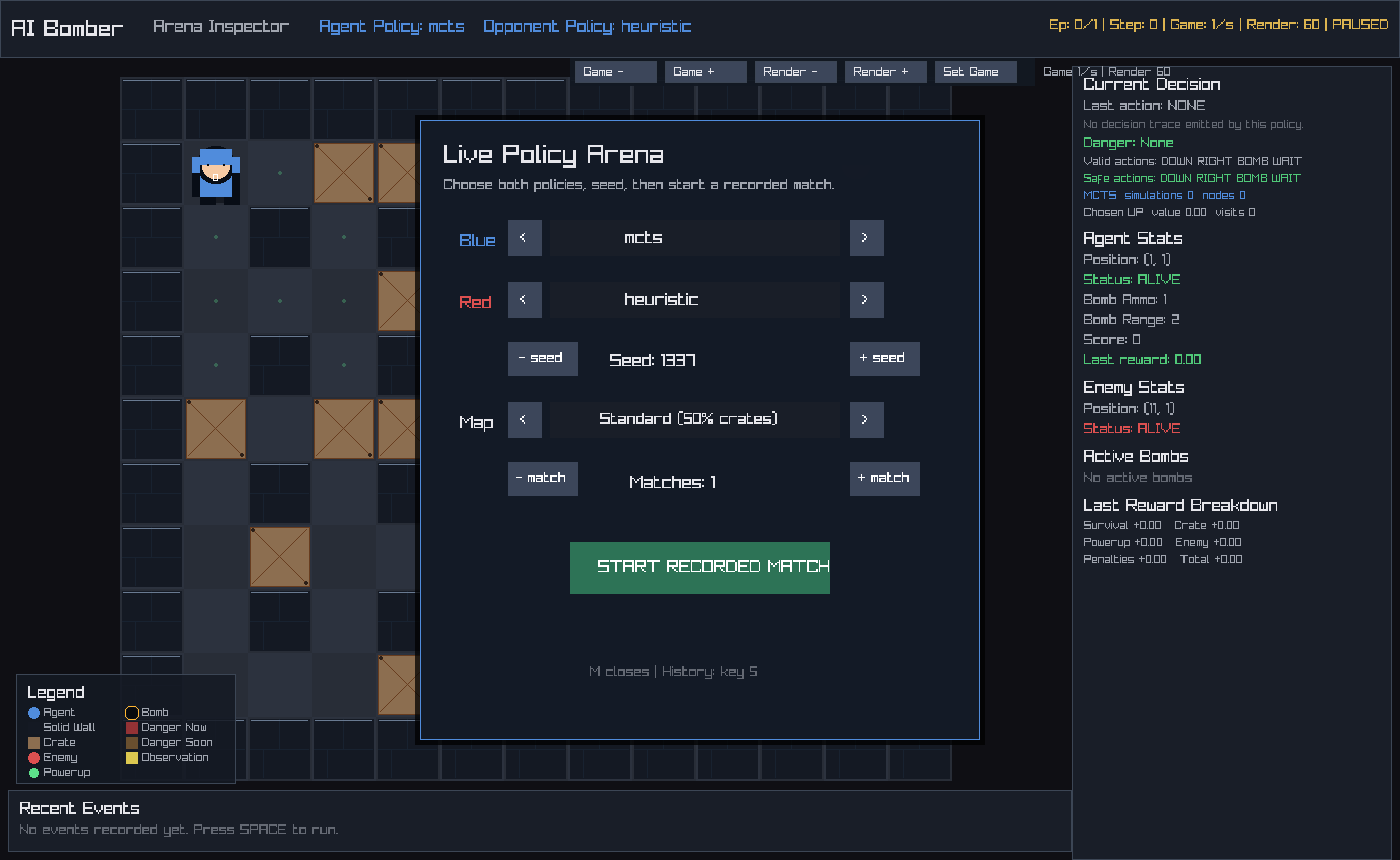
A Bomberman self-play project where win-cause audits retracted a strength claim and tactical gates stopped a later training run.
project details
I built a deterministic C17 game simulator and native C++/LibTorch training pipeline, then tested what its winning checkpoints actually did. An early strength claim failed when most wins proved to be arena-crush outcomes. Later work rebuilt training around an opponent ladder and tactical gates, and a saved-champion audit kept the deployed artifact distinct from the latest network.
- Headless simulator throughput: ~234,000 steps/sec, single core, no visualizer linked
- 12 CTest suites covering determinism, replay, reward, danger, and hardening
- 8 design docs; 59 C source and header files, 4,296 lines, ~146 KB across src/
- CI matrix: GCC + Clang (-Werror) and MSVC, full suite on every push and PR
- AlphaZero v1 iteration-70 checkpoint, untouched holdout: 66.02% vs native heuristic (41W-87D-0L), zero losses vs all opponents
Limitations
- At the case-study base commit (c50f423, 2026-07-06) there is no trained neural agent, only rule-based agents. The AlphaZero self-play campaign that followed (July 7 to 14, 2026) produced a real trained checkpoint and is covered in its own sections below, including one retracted claim.
- C17
- raylib
- Simulation
- C
- Agent self-play
quick links
project facts
- Category
- Games & Simulation
- Status
- research
- Context
- Personal
- Dates
- Jul 2026 – present
- Related
- AI Frogger, Dino Arena, Pulse Court
AI Frogger
project overview
View full case study >_
AI Frogger
research[ asset: ai-frogger-visual ]Screenshot or diagram for AI Frogger.A genetic policy learned to survive Frogger by moving sideways. A shared-seed evaluation exposed the difference between reward and crossing.
project details
I built a deterministic C17 Frogger environment, baseline agents, and a genetic trainer for a linear policy. The saved policy outscored two unsuccessful baselines on reward but completed no held-out crossings. Action counts, terminal reasons, and replay artifacts make the failure specific enough to guide a controlled follow-up.
What I built
- Built the seeded simulator, observations, rewards, terminal diagnostics, and shared agent interface.
- Implemented baseline policies, linear-policy inference, genetic training, and versioned weight persistence.
- Added metrics exports, replay support, and an optional raylib visualizer.
- Preserved a disjoint-seed comparison with source, configuration, and checkpoint identities, including the failed learned policy.
- 200 shared held-out maps per agent, 500-step limit (September 18, 2026; 8c368f9)
- Danger-aware baselines: 159/200 goals each; evolved policy: 0/200 (same comparison)
- 12/12 local tests passed in Release and Debug with assertions active (8c368f9)
Limitations
- One small training run and one fixed evaluation set, with no general superiority claim.
- The September 18 training candidates faced different maps. A later software repair gives them common comparison batches, without changing the reported results.
- Scripted and heuristic labels currently follow equivalent action-selection logic, so their equal scores are not independent algorithmic wins.
- Historical timeout totals use the terminal-reason export. The separate text counter was repaired on September 20 without changing those results.
- C17
- CMake
- raylib
- Simulation
- C
- Neuroevolution
- Evaluation methodology
quick links
project facts
- Category
- Games & Simulation
- Status
- research
- Context
- Personal
- Dates
- Jul 2026 – present
- Related
- AI Bomber, Dino Arena, Pulse Court
RuneLite CV Helper
project overview

RuneLite CV Helper
maintainedA 16.6k-line game-automation plugin decomposed into 22 bounded services, with a versioned HTTP contract and recovery ladders.
project details
Computer-vision and automation plugin for RuneLite, the open-source Old School RuneScape client. The V3 architecture decomposed a 16.6k-line monolith into 22 singleton services, each under 2k lines: coordination, a localhost HTTP API with a versioned JSON contract, entity export, input execution, login recovery, item and loot policy, BFS pathing, two skill farmers (mining, woodcutting) plus a mob farmer with combat AI, and a live browser diagnostics frontend. The guardrails are the showcase: client-thread-only bridges and a cycle-free injection graph.
- V3: 16.6k-line monolith decomposed into 22 services, each under 2k lines
- Cycle-free Guice injection graph
- 2 skill farmers (mining, woodcutting) + mob farming with combat, loot policy, and recovery logic
- Java
- Guice
- RuneLite
- HTTP APIs
- Systems design
- Modular decomposition
- Observability
- Recovery systems
quick links
project facts
- Category
- Systems
- Status
- maintained
- Context
- Personal
- Dates
- Jun 2026 – present
- Related
- OSRS Market Tools (MMG)
COMISA Modeling
project overview

COMISA Modeling
researchCurrent work: modeling for comorbid insomnia and sleep apnea (COMISA).
project details
My current focus at ResMed is modeling work around COMISA (comorbid insomnia and sleep apnea). Details, metrics, and outcomes are not published. This entry will grow as public-safe results are confirmed.
Limitations
- Current proprietary work. No technical details or results published.
- Python
- Machine learning
- Clinical modeling
quick links
- No public links yet.
project facts
Algorithmic Solvability
project overview
View full case study >_
Algorithmic Solvability
research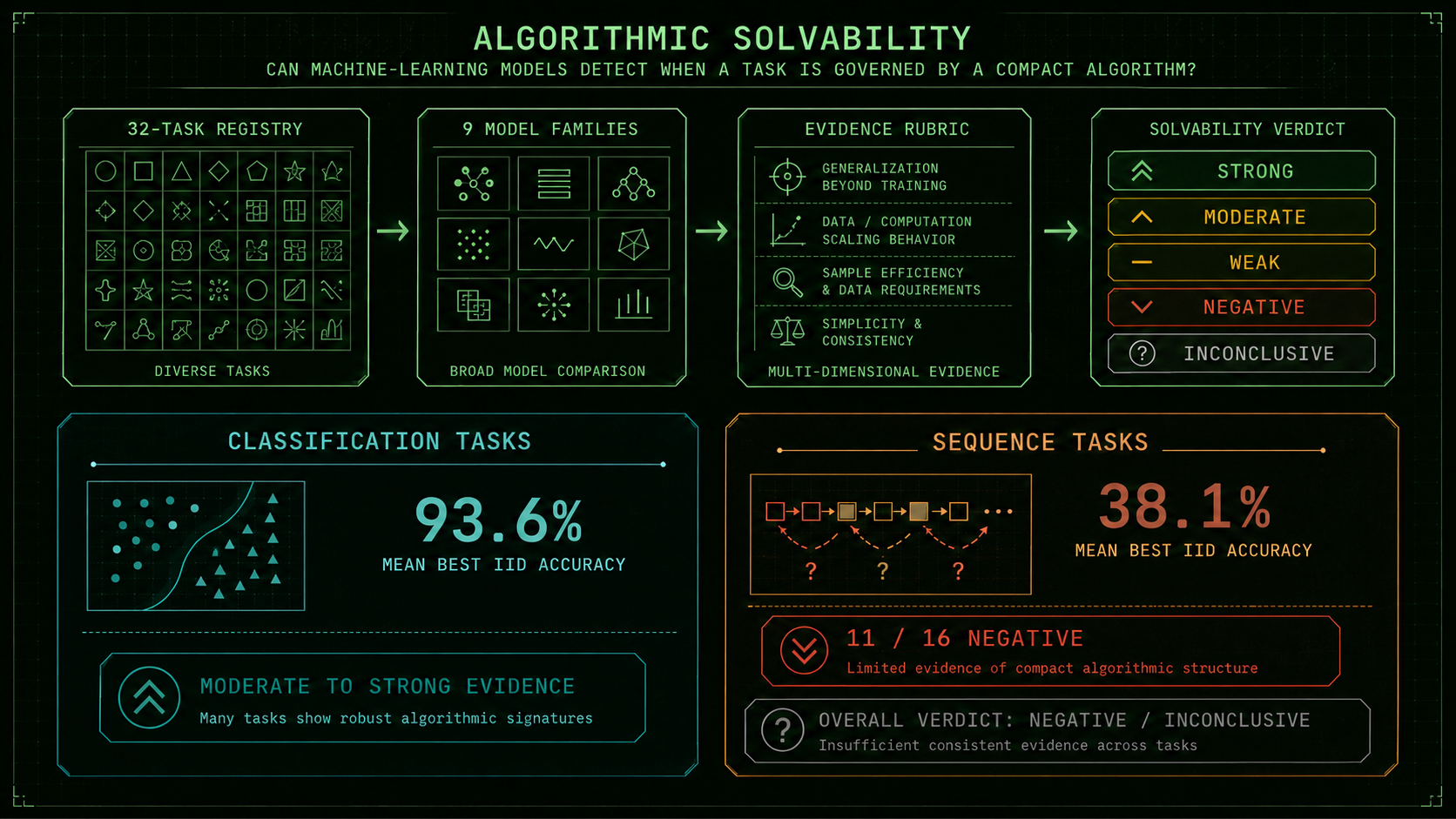
Controlled experiments on whether ML models detect that a task is governed by a compact algorithm.
project details
Research pipeline using a 32-task registry (17 sequence-transformation tasks, 15 tabular-classification tasks, each with a known reference algorithm) and 9 model families under distribution shift to separate algorithmic understanding from pattern matching. Produces 3 compiled research papers and 8 figures from its own results.
- 462/462 tests pass across 15 test modules, ~113s
- 32-task registry: 17 sequence tasks, 15 classification tasks; 9 model families
- Classification (14 scored tasks): 3 STRONG, 9 MODERATE, mean best IID accuracy 93.6%
- Sequence (16 scored tasks): 1 MODERATE, 11 NEGATIVE, mean best IID accuracy 38.1% despite a tuned LSTM
Limitations
- Solo, three-day build (52 commits, 2026-03-25 to 2026-03-27). Only the S0-S3 and C0-C3 task tiers are implemented; harder compositional tiers were deferred at the design stage and never built.
- No deployed service, API, or web UI. A local, CLI-driven pipeline that writes results and figures to disk.
- Python
- PyTorch
- scikit-learn
- Experimental design
- ML research
- Distribution shift
quick links
project facts
- Category
- ML Research
- Status
- research
- Context
- Personal
- Dates
- Mar 2026 – present
RingRoad
project overview
RingRoad
activeA mobile extraction-shooter prototype for iOS, built in Unreal Engine 5.7 and C++.
project details
March 2026 Week 3 prototype checkpoint of a mobile extraction shooter targeting iOS: first-person control, hitscan combat, a grid inventory, looting, and multi-map switching, in Unreal Engine 5.7 and C++. About 150KB of design docs back a planned 90-day vertical slice; this is v0.2 of that plan.
Limitations
- Early-stage prototype: v0.2 of a planned 90-day vertical slice. No player-facing build yet.
- Unreal Engine 5.7
- C++
- iOS
- Game development
- Unreal Engine
quick links
- No public links yet.
project facts
- Category
- Games & Simulation
- Status
- active
- Context
- Personal
- Dates
- Mar 2026 – present
WhisperKey
project overview

WhisperKey
archivedA Windows system-tray hotkey dictation tool with a cloud Whisper API default and an optional fully local engine, built but never merged out of a feature branch.
project details
WhisperKey is a Windows system-tray dictation tool: hold a hotkey, speak, and the transcription lands in your clipboard or gets typed directly into whatever field has focus. Transcription runs through OpenAI's Whisper API by default, with an optional fully local engine (Vosk-based) for when audio needs to stay on the machine instead of going to a cloud API. The tray app, the GUI with transcription history and OpenAI cost tracking, and the local engine are all real, about 6,000 lines of working code, but they exist only on an unmerged feature branch. The main branch is a single README, and nothing was ever packaged or released.
Limitations
- Lives entirely on an unmerged feature branch. The main branch is a single README, and nothing has ever been packaged or released.
- The local engine is present in the code, but nothing in the commit history shows it was run end to end. Treat it as designed, not demonstrated.
- Python
- OpenAI Whisper API
- Vosk
- Windows
- Speech recognition
- Desktop tooling
- GUI development
quick links
project facts
- Category
- Tools
- Status
- archived
- Context
- Personal
- Dates
- Jul 2025 – Aug 2025
Lifeline
project overview
View full case study >_
Lifeline
active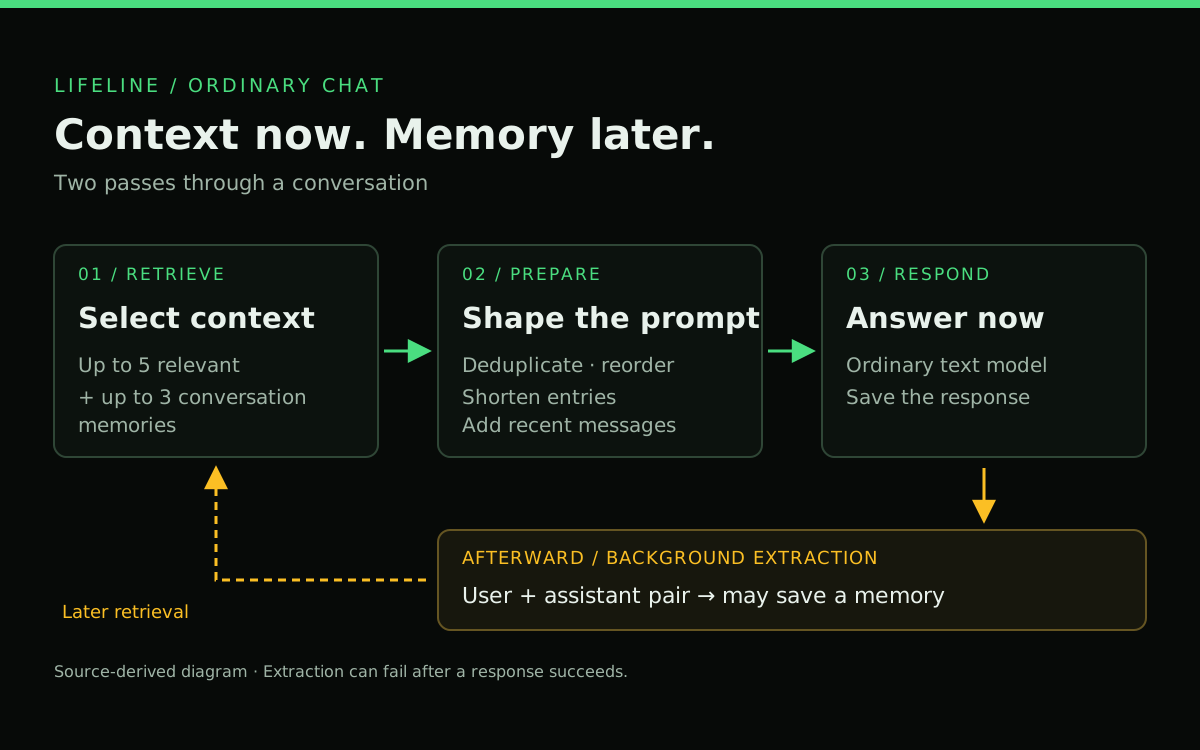
A personal-assistant prototype that extracts memories from conversations and selects context for later prompts using similarity, importance, and recency.
project details
I built a React and Django assistant with persistent memory, prompt inspection, and a separate LangGraph path for Gmail tools. Ordinary chat selects stored context before calling the language model, then starts memory extraction from the completed conversation pair. Historically deployed on EC2 with nginx, systemd, and SSL through GitHub Actions. Current hosted availability and runtime quality have not been independently verified.
- Ordinary chat: up to 5 scored memories plus 3 from the conversation
- Similarity threshold 0.3, followed by importance and recency weighting
- 16 fictional retrieval cases; production quality unverified
Limitations
- This page includes source traces and an isolated Django/SQLite memory-lifecycle probe with fictional data and fixed providers. Live chat, production scheduling, authentication and answer quality remain unverified.
- The inspected September 2026 source snapshot includes local changes to the chat view. File hashes identify those bytes separately from the repository commit.
- Python
- Django
- React
- LangGraph
- OpenAI API
- AWS EC2
- Agent systems
- Tool use
quick links
project facts
- Category
- Agent Systems
- Status
- active
- Context
- Personal
- Dates
- Jun 2025 – Sep 2025
- Related
- Dusk, Agent Toolkit
Dusk
project overview
View full case study >_Dusk
active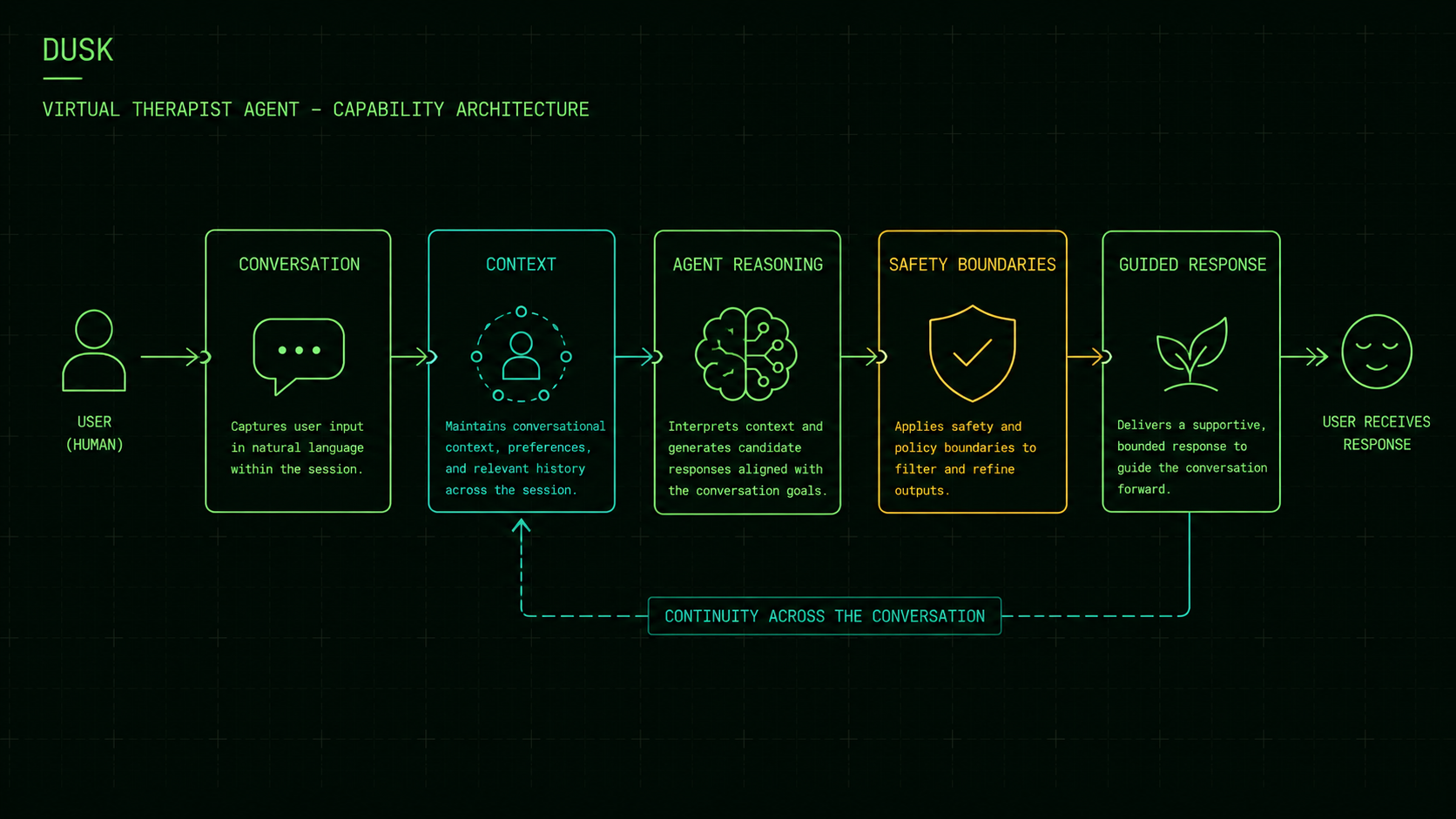
ResMed's public AI-powered sleep coach, with natural voice support, adaptive guidance, and personalized CBT-I plans. IP pending for the multi-agent CBT-I system.
project details
Dusk is now publicly presented by ResMed as a free, intelligent sleep-support coach designed to make personalized guidance available between moments of care. I built the underlying system from the ground up at ResMed, including its multi-agent architecture, retrieval, persistent memory, voice interaction, and supporting backend. ResMed's public page confirms its adaptive guidance, natural voice assistance, personalized CBT-I plans, and general-wellness boundary.
What I built
- Built Dusk from the ground up: the agent architecture, RAG pipeline, memory system, voice stack, and supporting backend.
Limitations
- Dusk is now publicly described by ResMed, but my implementation details remain proprietary and are limited here to public-safe capability patterns.
- IP is pending for the multi-agent CBT-I system. Public inventor profiles list reference P2852US1 (P+S 157222); I did not find a published patent application or grant and do not represent it as one.
- LangChain
- RAG
- Speech-to-text
- Text-to-speech
- Python
- Agent architecture
- Conversational AI
- Voice interfaces
quick links
project facts
- Category
- Agent SystemsHealthcare ML
- Status
- active
- Context
- ResMed
- Dates
- May 2025 – May 2026
- Related
- Dawn, COMISA Modeling, Lifeline
Meal Tracker
project overview

Meal Tracker
archivedA Django and React meal-tracking app built in about nine days: REST API design, JWT auth, and database modeling.
project details
A full-stack meal and macro tracker, called 'See Food' in the code, built in about nine days in July and August 2024: a Django REST Framework backend with JWT authentication and a modeled nutrition database, a React frontend, and a comprehensive test suite. The README advertises GenAI-based natural-language goal parsing, but that feature doesn't exist in the code. The goal-parsing endpoint is a stub that returns the literal value 42 for every nutrition goal, regardless of input.
Limitations
- Natural-language goal parsing is advertised in the README but not implemented: the endpoint is a hardcoded stub, not a working LLM call.
- Django
- React
- JWT
- REST
- REST API design
- Authentication
- Database modeling
- Testing
quick links
project facts
- Category
- Tools
- Status
- archived
- Context
- Personal
- Dates
- Jul 2024 – Aug 2024
Dawn
project overview
View full case study >_Dawn
active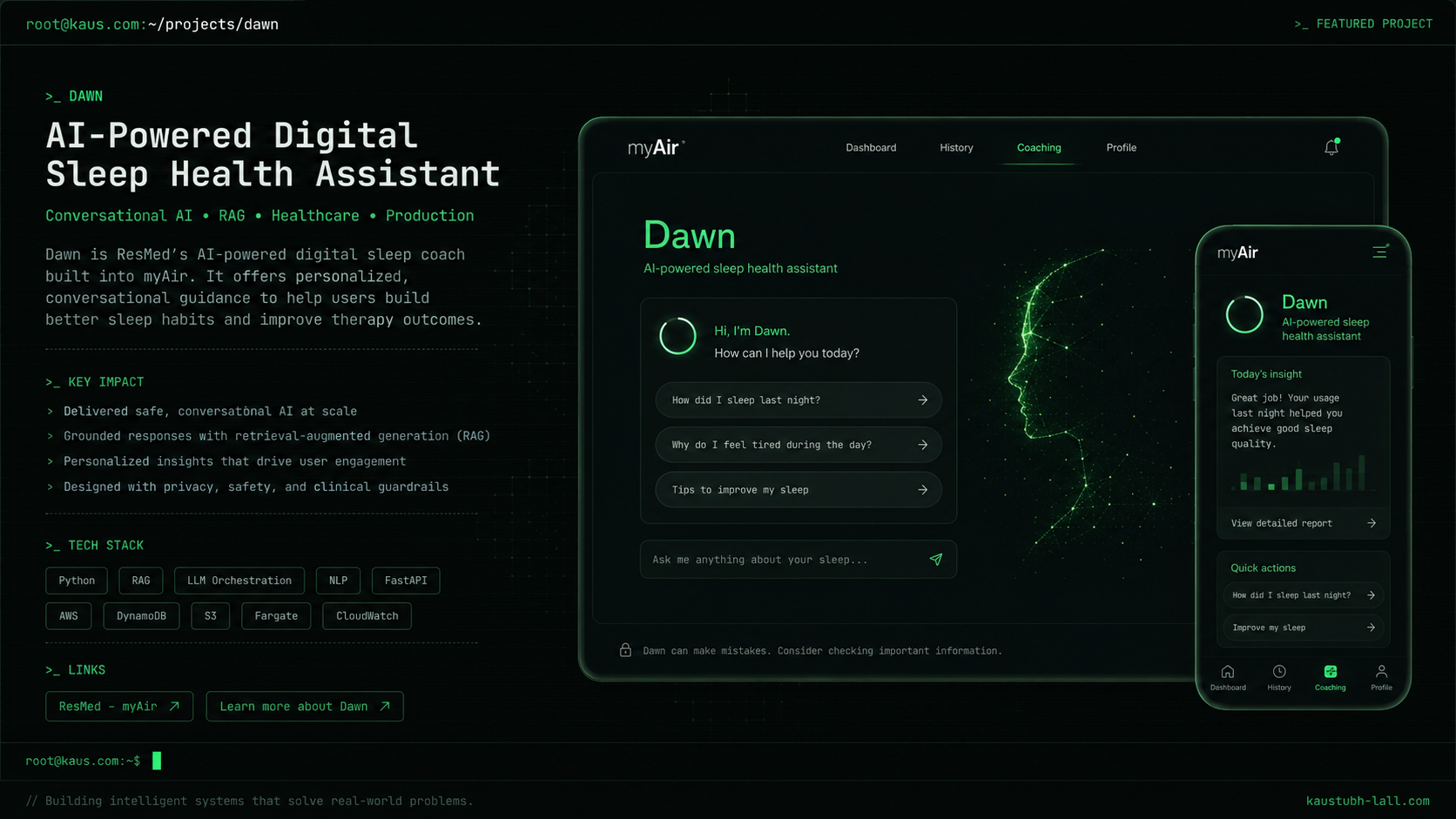
ResMed's AI-powered digital sleep-health assistant. I was one of the engineers who built it.
project details
Dawn is ResMed's generative-AI digital assistant for sleep health. I contributed to building Dawn as part of my machine-learning engineering work at ResMed. Public information about the product is described on ResMed's own channels. My personal contributions are described here only at the level that is public-safe.
What I built
- Built Dawn largely from the ground up as one of its core engineers, from early architecture through production launch.
- Built both of Dawn's surfaces, the myAir app experience and the web experience, on a single shared backend.
- 1.5M+ beta enquiries (publicly reported product milestone)
Limitations
- Dawn is a ResMed product built by a team. This page describes the product from public sources and my role at a public-safe level, without internal implementation details.
- LLMs
- Python
- Cloud infrastructure
- Conversational AI
- LLM systems
- Production ML
quick links
project facts
- Category
- Healthcare ML
- Status
- active
- Context
- ResMed
- Dates
- Feb 2024 – present
- Related
- Dusk, COMISA Modeling, Lifeline
HonestReviewer
project overview

HonestReviewer
archivedA Django app that uploads Amazon review CSVs and flags fraud or low-helpfulness reviews via Cohere's classification API with hand-written few-shot examples.
project details
A local Django web app that uploads a CSV of Amazon product reviews and runs them through Cohere's text-classification API to flag fraudulent or low-helpfulness reviews, using a hand-written set of few-shot examples as the classifier's labels. Built in a single overnight session in December 2023: the git history is one bulk upload commit, but Django migration timestamps show the models, the classification schema, and the Cohere integration were all written in one sitting. This is a working prototype, not a deployable tool, and the classification pipeline was never run against the included dataset in a way that left a recorded result.
Limitations
- A Django secret key and a live-looking Cohere API key are committed to the repo in plaintext, along with the SQLite database. No .gitignore, no requirements file.
- Django
- Cohere API
- SQLite
- Few-shot classification
- CSV data pipelines
- Web development
quick links
- No public links yet.
project facts
- Category
- Tools
- Status
- archived
- Context
- Personal
- Dates
- Dec 2023
PacMan AI
project overview
View full case study >_
PacMan AI
archived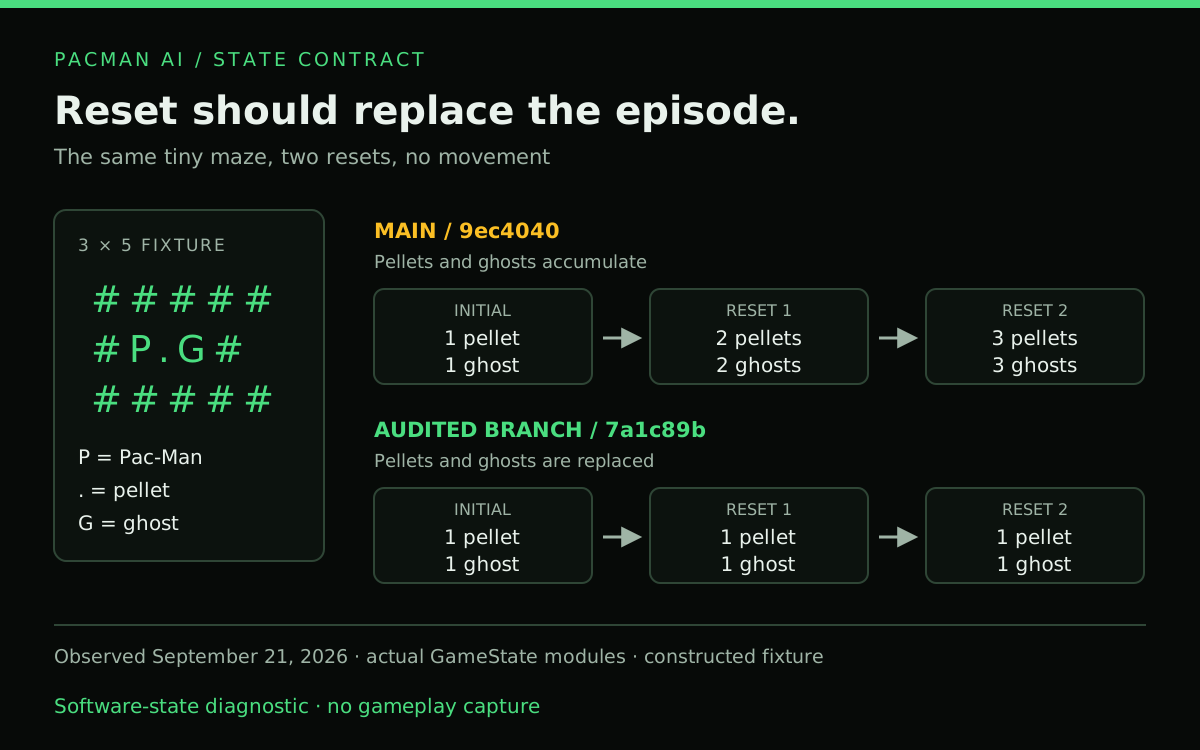
A pygame Pac-Man testbed for NEAT and DQN, with a source audit showing how reset, observation and replay-buffer bugs can undermine an experiment.
project details
I built a Pac-Man clone in Python and pygame and explored neuroevolution and deep Q-learning around it. A later audit found problems in the environment and training setup that needed attention before agent results could be interpreted. This case study compares the public main revision with an unmerged repair branch using small, reproducible state checks. It explains the repairs, the remaining replay-tree defect, and the evaluation work still needed.
Limitations
- The audit ran deterministic state and replay-tree checks. It did not run a policy, train a model, deserialize historical replays or verify the graphical game.
- Both revisions fail when inserting into a replay tree with capacity one. CLI behavior was inspected in source only, and agent quality remains unbenchmarked.
- Python
- pygame
- NEAT
- Deep Q-Learning
- Keras
- TensorFlow
- Neuroevolution
- Reinforcement learning
quick links
project facts
- Category
- ML Research
- Status
- archived
- Context
- Personal
- Dates
- May 2023 – Jan 2024
- Related
- NEAT Playground
Chambal Awareness Website
project overview

Chambal Awareness Website
archivedA pro bono website for a river-restoration nonprofit in Kota, India, built in four days and deployed to Firebase.
project details
A React and Bootstrap awareness website built pro bono for an environmental organization working on Chambal river restoration in Kota, India. Built in four days and deployed to Firebase.
- React
- Bootstrap
- Firebase
- Frontend development
- Web deployment
quick links
project facts
- Category
- Tools
- Status
- archived
- Context
- Personal
- Dates
- Dec 2019 – Jan 2020
MSK Research
project overview

MSK Research
archivedU-Net segmentation research for musculoskeletal MRI, a three-week summer exploration in Keras and TensorFlow.
project details
Research repo exploring U-Net-based segmentation on musculoskeletal MRI, built over about three weeks in the summer of 2019: a Keras/TensorFlow training pipeline, a data-augmentation pipeline, and multiple trained checkpoints. A related Django web app, msk-api, tried to put that kind of model behind a simple interface: log in, upload an image, get a result. It was built between January and July 2020 and abandoned after about five months. The login-gated upload page works, but the model was never wired in: the inference call is a two-line stub that returns nothing, and the task queue meant to control access to it never got past a note in the repo.
Limitations
- Minimal README. Image data is not checked into the repo, and no results were published from this work.
- The msk-api web app never got the model working: the inference endpoint is a stub, and the task queue for controlling access to it was only ever a planned note.
- Python
- Keras
- TensorFlow
- U-Net
- Django
- Medical imaging
- Segmentation
- Deep learning
quick links
- No public links yet.
project facts
- Category
- Healthcare ML
- Status
- archived
- Context
- Personal
- Dates
- Jul 2019 – Jul 2020
NEAT Playground
project overview
View full case study >_
NEAT Playground
active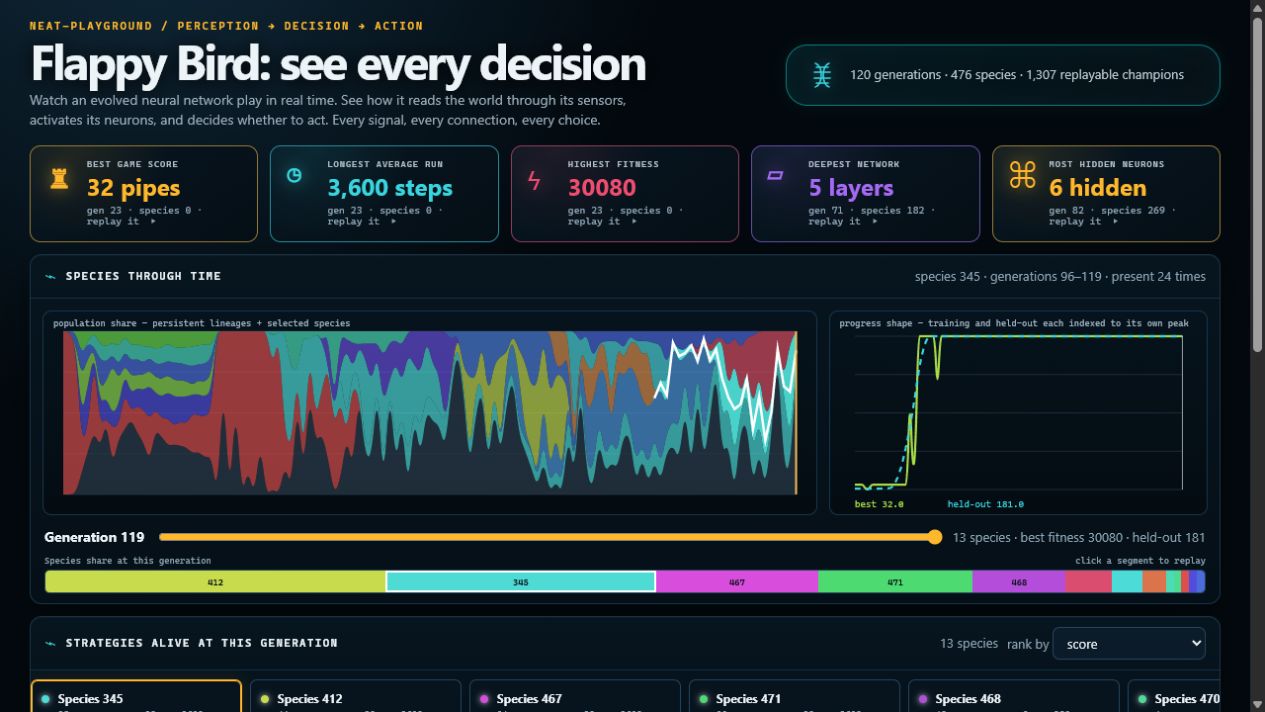
NEAT neuroevolution implemented from scratch in C, evolving neural nets that play Flappy Bird, Snake, 2048, and Pac-Man, with interactive replay visualizers you can run in the browser.
project details
A from-scratch C implementation of NEAT (NeuroEvolution of Augmenting Topologies) that evolves small neural networks to play four arcade games, using episode fitness without action labels or gradient descent. Recorded evolution histories replay in interactive browser visualizers showing the network, its sensors, and its decisions.
- Repository-reported throughput: ~60M agent-steps/second/core
- 2048 learning study: 102.6 mean maximum tile across 5 final test batches
- 2048: a late score increase after a plateau around generations 170 to 200
- 20 retained learning runs, 4,500 generation records available as CSV
- C99
- NEAT
- SDL2
- HTML/JS visualizers
- Neuroevolution
- C
- Simulation design
- Visualization
quick links
project facts
- Category
- Games & Simulation
- Status
- active
- Context
- Personal
- Dates
- Apr 2019 – present
- Related
- AI Bomber, AI Frogger, Dino Arena, PacMan AI
Drug Transporter ML
project overview
View full case study >_Drug Transporter ML
archived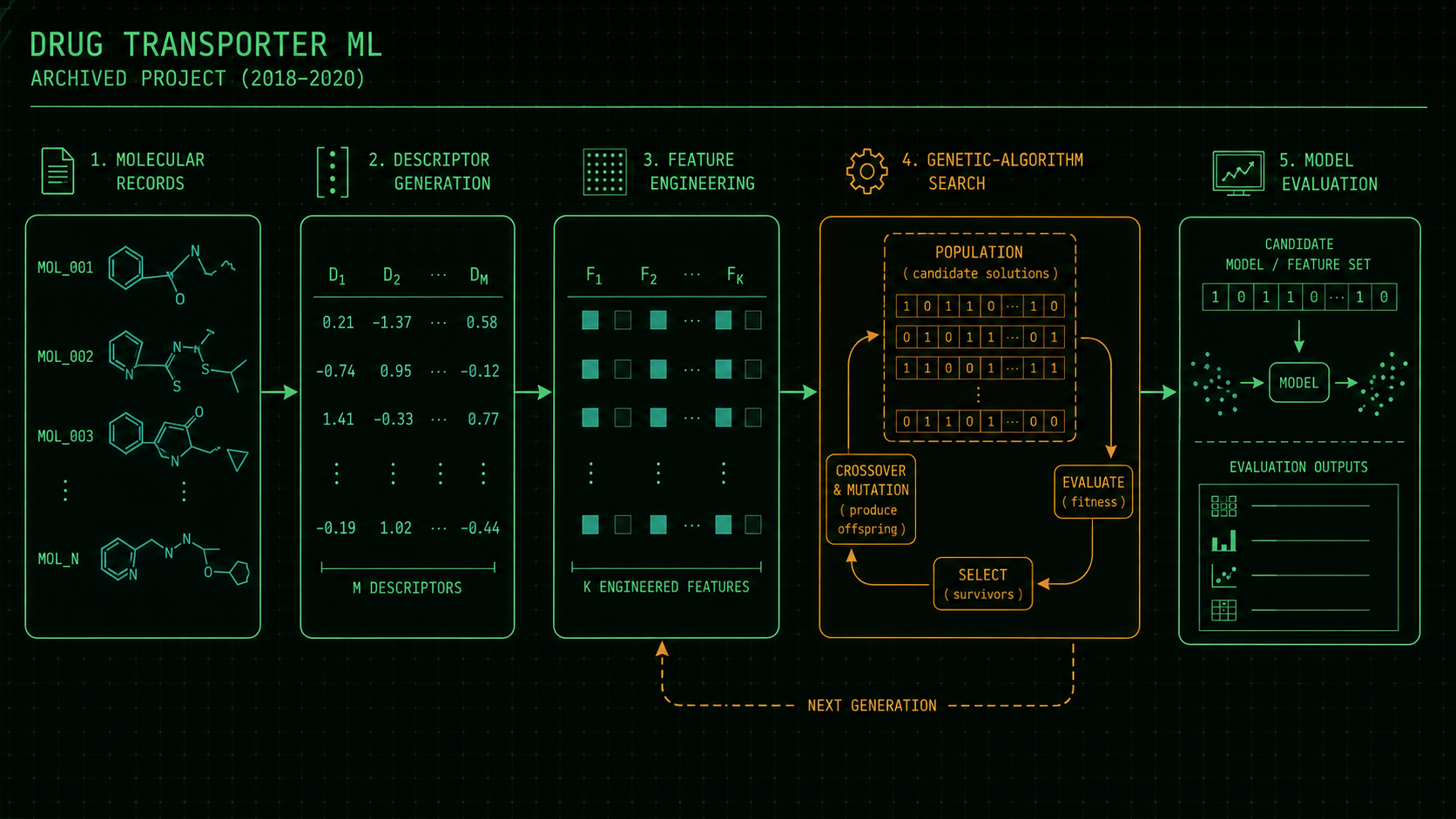
The code behind a cited biomedical publication (Journal of Biological Chemistry, 2020).
project details
An archived Python research implementation for OAT1/OAT3 substrate classification, combining feature-subset search and NEAT. A reproduction audit separates the published study, historical scratch runs, and what the consolidated code actually does.
- 3 bundled metabolite datasets, 32 molecular descriptor columns
- 2020 Journal of Biological Chemistry publication
- 10 passing software checks on repair a88149c, with synthetic GA execution
Limitations
- The default-branch snapshot at 4cd3f66 has correctness and startup defects. Repair a88149c passes ten bounded checks and is published for review, but is not merged. Use the linked repair commit to reproduce the new checks.
- The published paper, archived code, and later maintenance checks are separate evidence. This audit does not reproduce the paper's experiments or establish a new accuracy result.
- Python
- scikit-learn
- NEAT
- Cheminformatics
- Feature engineering
- Genetic algorithms
quick links
project facts
- Category
- Healthcare ML
- Status
- archived
- Context
- UC San Diego
- Dates
- May 2018 – May 2020
